The term gets thrown around a lot in small business circles these days. AI receptionist. Virtual front desk. Intelligent answering assistant. Depending on who is selling it, an AI receptionist is either the solution to every staffing headache you have ever had or an overhyped piece of software that will frustrate your customers and make your business feel cold and impersonal.
The truth, as usual, sits somewhere in the middle — but it leans more useful than most skeptics expect, and more limited than most vendors will admit.
This post is going to give you an honest picture of what an AI receptionist actually is, what it can and cannot do, and how to think clearly about whether your business genuinely needs one or whether you are solving a problem you do not really have.
What an AI Receptionist Actually Is
At its core, an AI receptionist is a software system that handles incoming communications — phone calls, text messages, website chats, social media messages, or some combination of these — automatically, without a human being present.
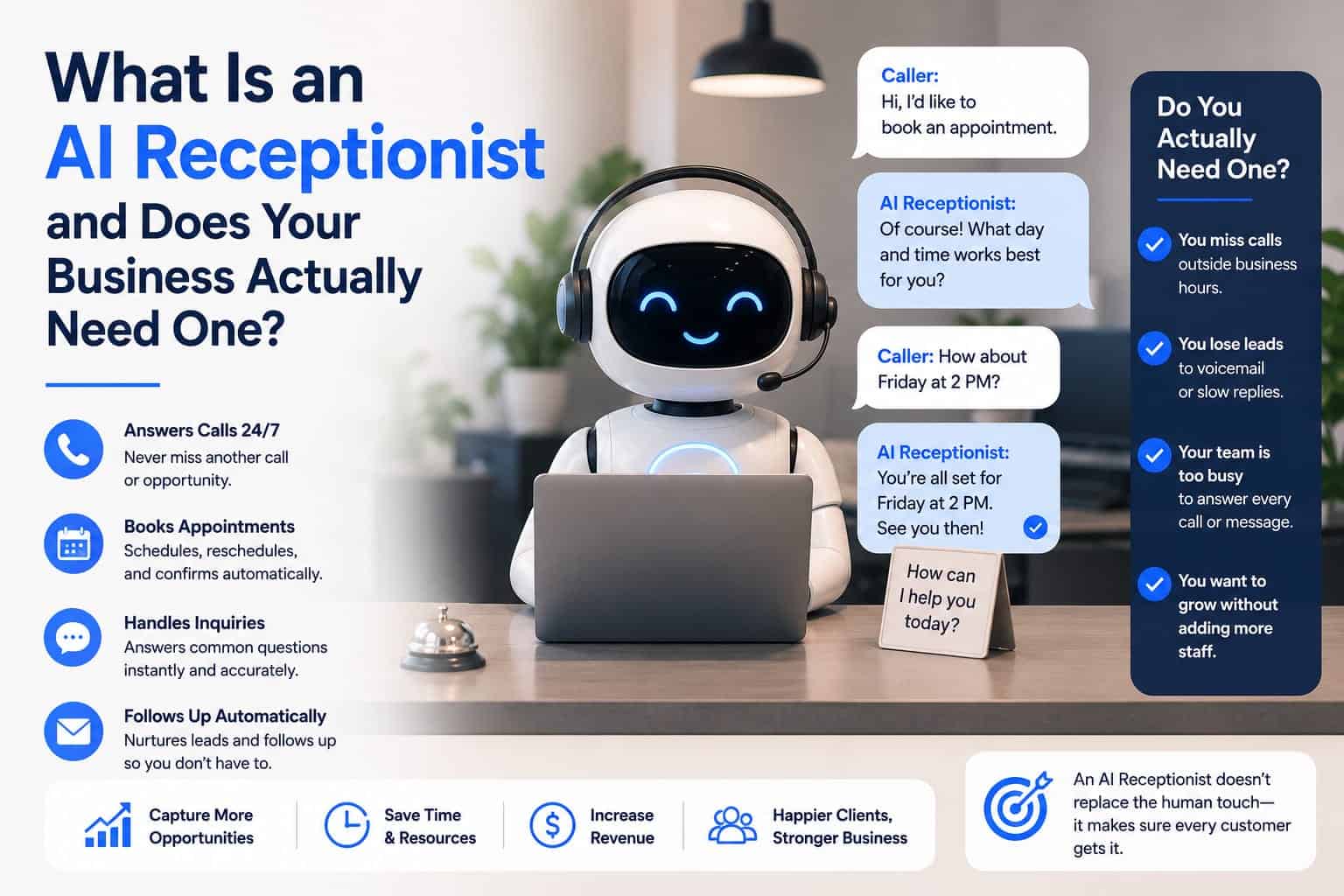
It receives the inquiry, understands what the person is asking or needs, responds in a natural conversational way, and either resolves the situation entirely or routes it to the right person on your team. Depending on the platform, it can book appointments, answer questions about your services and pricing, collect contact information, send follow-up messages, handle basic complaints, and escalate anything complex to a live team member.
Modern AI receptionists are built on the same underlying language technology that powers tools like ChatGPT. This means they can understand natural, conversational language rather than requiring callers to navigate rigid menu options. Someone can say “I need to move my appointment from Thursday to sometime next week, preferably in the morning” and the system understands the full request and acts on it.
This is a meaningful leap forward from the automated phone systems most of us grew up hating. The old systems forced you into a maze of “press 1 for billing, press 2 for support.” The new ones have an actual conversation with you.
What It Can Do Well
Let’s start with the genuine strengths, because they are real and they matter for the right kind of business.
Availability is the most obvious one. An AI receptionist is on duty every hour of every day without overtime, sick days, scheduling conflicts, or bad mornings. For businesses that receive inquiries outside of regular hours — and most do, because customers live their lives on their own schedule — this means no lead goes unanswered at 9 PM on a Sunday because your office is closed.
Volume handling is another legitimate advantage. A human receptionist can handle one call at a time. On a busy morning when four people call simultaneously, someone is going on hold or going to voicemail. An AI receptionist handles all four at once with no degradation in response time or quality.
Consistency is underrated. Human receptionists have good days and bad days. They get stressed, they forget things, they occasionally say the wrong thing to the wrong person. An AI receptionist delivers the same quality of response every single time, which matters more than people realize when you consider that a first impression is being made on every single incoming call or message.
Routine task handling is where AI receptionists genuinely save time. Appointment scheduling, rescheduling, cancellations, directions to your office, hours of operation, basic pricing questions, intake form collection — these tasks take up a disproportionate amount of a human receptionist’s day. Automating them frees your team to focus on work that actually requires human judgment, empathy, and expertise.
What It Cannot Do Well
Here is where honest vendors should spend more time.
Complex emotional situations require a human. A patient calling to discuss a difficult diagnosis, a client who is upset about how their last visit went, someone going through a hard time who needs to feel genuinely heard — these situations demand human warmth, real empathy, and the kind of intuitive responsiveness that no software currently replicates in a meaningful way. An AI that delivers a smooth, pleasant response to someone in genuine distress can actually make things worse by feeling hollow and dismissive precisely when the person needed to feel understood.
Nuanced judgment calls are beyond current AI capabilities. A long-term client asking for an exception to your cancellation policy because of a family emergency. A situation where the right answer depends on context that is not in the system. A conversation that starts as a routine inquiry but reveals something the business owner genuinely needs to know about immediately. These require a human who can read the situation and respond appropriately.
Highly technical or specialized questions often fall short. If your business involves complex services, custom quotes, or specialized expertise, an AI receptionist will hit its ceiling quickly. It can handle the surface-level questions but starts to struggle — and sometimes confidently provides wrong information — when the inquiry gets genuinely specific and technical.
Building relationships is something AI assists with but cannot own. Your best clients are loyal because they feel known. Because Maria at the front desk remembers that they prefer early morning appointments and always asks about their kids. That relational texture is built by humans over time, and no AI system currently substitutes for it.
The Businesses That Benefit Most
Not every business needs an AI receptionist, and being clear about which ones do saves everyone from an expensive and disruptive experiment that was never going to work.
The businesses that benefit most tend to share a few characteristics. They receive a high volume of routine, predictable inquiries. They experience significant after-hours contact that currently goes unanswered. Their existing team spends a disproportionate amount of time on administrative communication rather than their core work. They are losing leads or frustrating customers because response times are too slow.
Specific industries where AI receptionists are delivering consistent value right now include medical and dental practices, law firms handling initial intake calls, real estate agencies, salons and spas, home service businesses like HVAC and plumbing, fitness studios, and any service business that lives or dies by its appointment schedule.
What these businesses share is a high volume of relatively standardized incoming communication — booking requests, availability questions, service inquiries, confirmations — that does not require deep expertise or emotional sensitivity to handle.
The Businesses That Should Think Twice
If your business is built primarily on high-touch, highly personalized client relationships where every interaction carries significant weight — boutique consulting, therapy practices, high-end financial advisory, bespoke creative services — an AI receptionist may create more problems than it solves. Your clients chose you specifically because they value the human element, and putting a chatbot between them and your team at the first point of contact can signal exactly the wrong thing about your priorities.
If your call volume is genuinely low and your team handles incoming communication without strain, you may simply not need one. The tool solves a real problem — it just might not be your problem.
If your brand is built on warmth, intimacy, and personal connection, you need to think carefully about where automation fits and where it undermines what makes you worth choosing in the first place.
The Hybrid Approach Most Businesses Get Wrong
Here is something most people implementing AI receptionists do not think about carefully enough upfront: the handoff.
The moment that matters most in any AI receptionist setup is not when the AI handles a call perfectly. It is what happens when the AI reaches the limit of what it can handle and a human needs to take over. If that transition is clumsy — if the client has to repeat themselves, if there is a delay, if the handoff feels abrupt — it erases much of the goodwill the automation was meant to create.
The best implementations design the handoff as carefully as they design the AI conversation itself. The AI collects the relevant information, summarizes the situation for the team member taking over, and frames the transition in a way that feels natural to the client. “Let me connect you with someone who can help with that specifically” — and then it actually does, smoothly and quickly.
The worst implementations use AI as a wall between the client and the business rather than a bridge. Clients who can’t reach a human when they genuinely need one become frustrated clients, and frustrated clients tell people.
What to Look for If You Decide to Move Forward
If you have read this far and you think an AI receptionist makes sense for your business, here are the things that actually matter when evaluating platforms.
Integration with your existing systems is non-negotiable. An AI receptionist that cannot connect to your booking software, your CRM, or your calendar is going to create more manual work than it saves. Make sure any platform you consider connects cleanly with the tools you already use.
Customization of tone and voice matters more than most demos reveal. The default personality of most AI receptionist platforms is fine for nobody in particular. You need to be able to configure it to sound like your business — warm if you are warm, professional if you are professional, with the specific information and language that reflects who you are.
Escalation logic should be clearly defined before you go live. What types of calls or messages should always go to a human? Under what conditions should the AI recognize that it is out of its depth and hand off immediately? These parameters need to be set deliberately, not left to default settings.
Transparency with your clients is worth considering. Some businesses choose to be upfront that an initial response is automated while a team member follows up. Others configure their AI to feel as seamless as possible. Neither approach is universally right, but you should make the choice consciously based on your client base and brand values.
An AI receptionist is a genuinely useful tool for the right business in the right situation. It solves real problems — missed leads, slow response times, after-hours silence, front desk overload — in a way that is increasingly affordable and increasingly capable.
It is not a replacement for human connection, and businesses that treat it as one will pay that price in client relationships and reputation.
The question is not whether AI receptionists work. They do, for the right use cases. The question is whether your specific business has the specific problems they solve — and whether you are willing to implement one thoughtfully enough to capture the benefits without sacrificing what makes your business worth calling in the first place.
If the answer to both is yes, it is probably time to stop losing leads to voicemail and start letting technology handle the routine so your people can focus on the work that actually requires them.