There is a moment that happens dozens of times a week in med spas across the country. Someone fills out a contact form asking about Botox. Someone sends a DM on Instagram asking about pricing for a lip filler consultation. Someone calls during a busy treatment hour, gets voicemail, and hangs up without leaving a message. Someone clicks the “book a consultation” button on your website at 11:30 on a Thursday night.
And then nothing happens fast enough.
By the time your front desk gets to that inquiry — maybe an hour later, maybe the next morning — that person has already submitted the same question to two other clinics in your area. One of them responded in four minutes. That is where the consultation is going.This is not a marketing problem. You already generated the lead. This is a follow-up problem, and it is costing med spas an enormous amount of revenue every single month without most owners ever seeing exactly where the money is going.
Why Med Spa Leads Are Different
Before we talk about solutions, it is worth understanding why med spa leads require a different level of urgency than, say, a dental cleaning or a gym membership inquiry.
Med spa services are deeply personal. A woman considering her first Botox treatment has probably been thinking about it for months. She has done research, compared clinics, read reviews, and worked up the nerve to finally reach out. That moment of reaching out is emotionally charged. She is curious, a little vulnerable, and quietly hoping someone will respond in a way that makes her feel understood and welcomed rather than processed like a transaction.
When she gets silence — or a generic auto-reply that says “we’ll get back to you within one business day” — that emotional momentum dies. She either loses her nerve, moves on to a competitor, or convinces herself she’ll try again later, which often means never.
The window between a med spa inquiry and a booked consultation is narrow. Research across service-based industries consistently shows that responding within five minutes dramatically increases conversion rates compared to waiting even thirty minutes. In a competitive market with multiple clinics offering similar treatments, speed and warmth are often the only differentiators that matter at that first point of contact.
The Four Ways Most Clinics Are Losing Consultations
Understanding where the breakdown happens is the first step to fixing it. Most med spas lose leads in one of four predictable places.
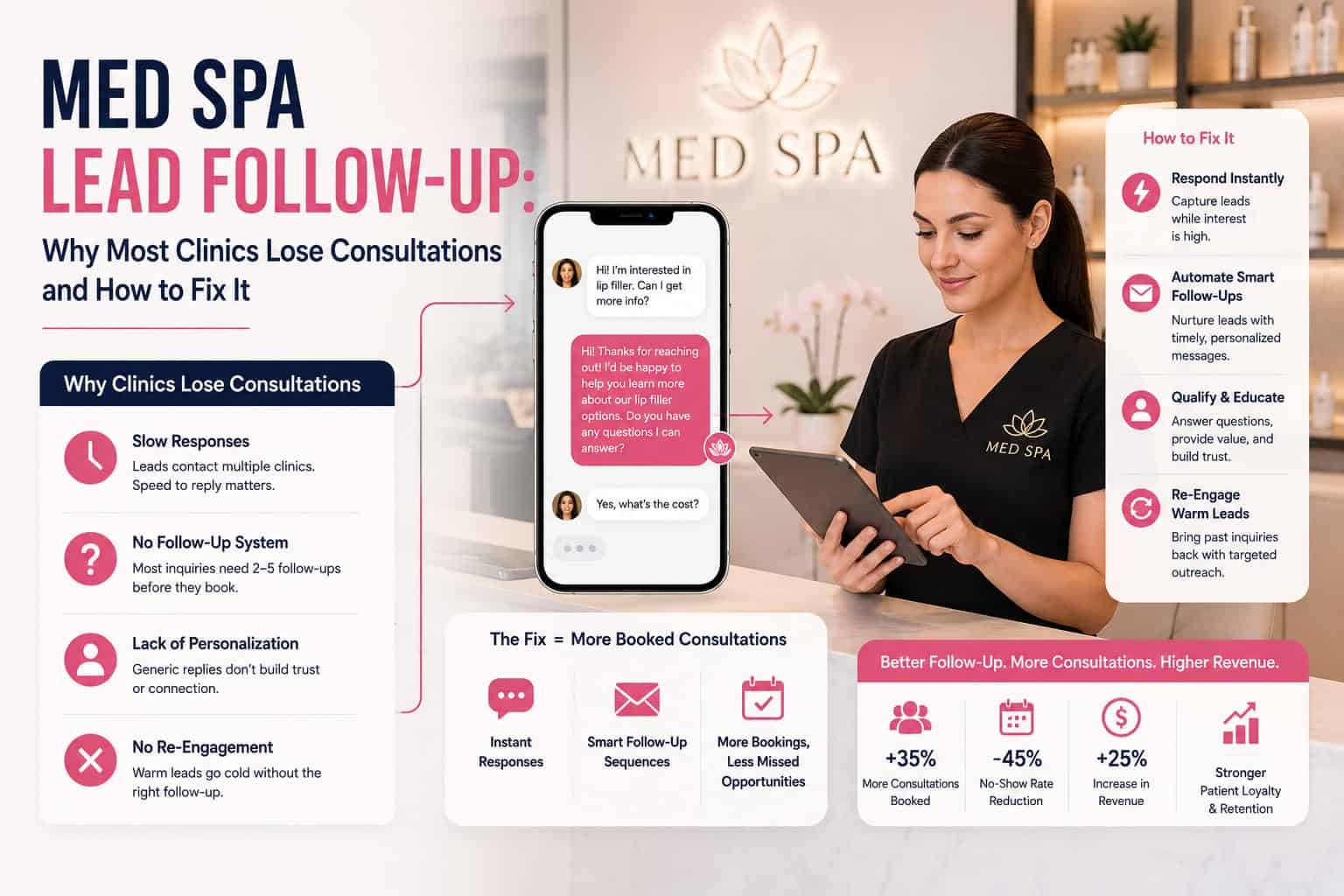
The first is slow response time. This is the most common and most damaging. Leads that come in outside business hours — evenings, weekends, lunch hours — often sit untouched for eight to twelve hours or more. By morning, the lead is cold. The person has moved on, booked elsewhere, or simply lost the impulse that drove them to reach out in the first place.
The second is inconsistent follow-up. Even when a first response goes out reasonably quickly, the follow-through often falls apart. A lead responds to your initial message but then doesn’t commit to booking. Your front desk means to follow up but gets busy with patients in the clinic. That lead gets lost in a text thread or an email inbox and nobody circles back. This is not laziness — it is just the reality of running a busy clinic where the in-person experience always takes priority over the inbox.
The third is impersonal communication. Med spa clients are not buying a commodity. They are entrusting someone with their face. When the first message they receive from your clinic feels like a form letter — all business, no personality, no warmth — it creates a disconnect between the experience they hoped for and the one they’re getting. First impressions in this industry carry enormous weight.
The fourth is friction in the booking process itself. Even when a lead is warm and interested, if booking a consultation requires a phone call during business hours, navigating a complicated scheduling page, or waiting for someone to manually check availability and get back to them, a meaningful percentage of interested people will simply not follow through. Every extra step between interest and booking is an opportunity for someone to drop off.
What the Clinics Getting It Right Are Doing Differently
The med spas that consistently convert inquiries into consultations have solved one fundamental problem: they have made sure that no lead ever experiences silence.
The most effective approach right now combines AI-powered instant response with a warm, human-feeling communication style and a frictionless path to booking.
When a new inquiry comes in through any channel — website form, Instagram DM, Google Business message, missed call, text — an AI assistant responds within seconds. Not with a robotic confirmation message, but with something that actually opens a conversation. Something like: “Hi, thanks so much for reaching out to us! We’d love to help. Are you interested in learning more about a specific treatment, or would you like to set up a complimentary consultation to talk through your options?”
That single message does three things. It acknowledges the person immediately so they feel seen. It invites them to share more so you can personalize the follow-up. And it positions the consultation as the natural next step without feeling pushy.
From there, the AI handles the back-and-forth — answering questions about treatments, sharing pricing ranges, describing what to expect during a consultation — and moves the conversation toward booking. When the prospect is ready, it offers available times directly in the conversation and confirms the appointment on the spot.
For leads that express interest but don’t book immediately, the system follows up automatically over the next several days with gentle, relevant touchpoints. Not aggressive sales messages, but thoughtful check-ins. “We still have a few consultation spots open this week if you’d like to come in and chat.” Or a piece of educational content relevant to the treatment they asked about. Consistent, low-pressure follow-up that keeps your clinic top of mind without feeling like a hard sell.
The Role of Personalization
One thing that separates the best med spa communication systems from the mediocre ones is personalization — and this matters more in aesthetics than in almost any other industry.
A woman asking about Botox for the first time has completely different concerns than someone who has been getting treatments for five years and wants to try a new provider. A client asking about body contouring is in a different emotional space than someone interested in a hydrafacial. Generic responses that treat all of these inquiries the same way miss the nuance entirely.
Good AI systems allow you to segment by treatment interest, new versus returning client status, and the specific questions being asked, so the responses and follow-up sequences feel relevant to that individual person’s situation. When a first-time Botox inquiry gets a message that specifically addresses the common questions and concerns of someone new to injectables, it builds trust in a way that a one-size-fits-all response never could.
Your clinic’s voice and personality should come through in every message as well. Whether your brand is warm and nurturing, clean and clinical, or fun and approachable, that tone should be consistent from the very first automated response all the way through the booking confirmation. Clients pick up on brand coherence even when they can’t articulate what they’re sensing. It builds confidence.
Handling the Consultation Itself
It is worth noting that fixing your follow-up process does more than just increase bookings. It also changes the quality of the consultations you do have.
When a client arrives for a consultation having had a warm, responsive, personalized experience leading up to it, they are already more trusting and more committed. They are less likely to be shopping around, less likely to be price-sensitive, and more likely to move forward with treatment. The follow-up experience shapes their perception of your clinic before they ever walk through the door.
Compare that to a client who had to chase you down, waited a day and a half for a response, and got a generic email when they finally heard back. That client arrives on the defensive, already slightly disappointed, already comparing you to other options. You are spending the first ten minutes of the consultation recovering from a bad first impression rather than building on a good one.
Measuring What You're Losing
If you are not sure how significant this problem is in your own clinic, here is a simple exercise. Pull your inquiry data from the past 90 days across all channels — your website form submissions, missed calls, social media messages, and any other inbound contacts. Count how many total inquiries came in. Now count how many of those converted to booked consultations.
For most med spas, that conversion rate falls somewhere between 20 and 35 percent. Clinics with strong follow-up systems consistently convert at 50 to 65 percent or higher.
The difference between those two numbers, multiplied by your average consultation-to-treatment conversion rate and your average treatment value, is a concrete dollar figure. For most active med spas, it lands somewhere between $8,000 and $25,000 in monthly revenue that is being generated as a lead and then lost before it ever becomes a client.
That number tends to focus the mind.
Where to Start
If you are ready to address this, you do not need to overhaul your entire operation. Start with two things.
First, make sure every inbound inquiry gets a response within five minutes, around the clock, seven days a week. If your team cannot provide that, an AI assistant can. This single change will have a more immediate impact on your consultation bookings than almost anything else you could do.
Second, build a follow-up sequence for leads that do not book immediately. Three to five touchpoints over seven to ten days, each one warm and relevant, each one making it easy to take the next step. Most of your unconverted leads are not saying no — they are saying not yet. Consistent follow-up is how you are there when they become ready.
The leads are already finding you. They are already interested. They just need to feel that your clinic is as attentive and caring before they book as it will be when they are sitting in your treatment room.
That feeling starts the moment they reach out. Make sure it starts well.