If you run or manage a dental office, you already know the particular frustration of a no-show. The chair sits empty. The hygienist stands around. The slot that could have gone to a patient on your waitlist is gone forever. Unlike a retail store that can restock a product, you cannot recover lost appointment time. It is the most perishable thing in your practice.
The national average no-show rate for dental offices hovers somewhere between 10 and 15 percent. For some practices, it climbs higher. Multiply that by your average production per appointment and you start to see how significantly this one problem affects your annual revenue.
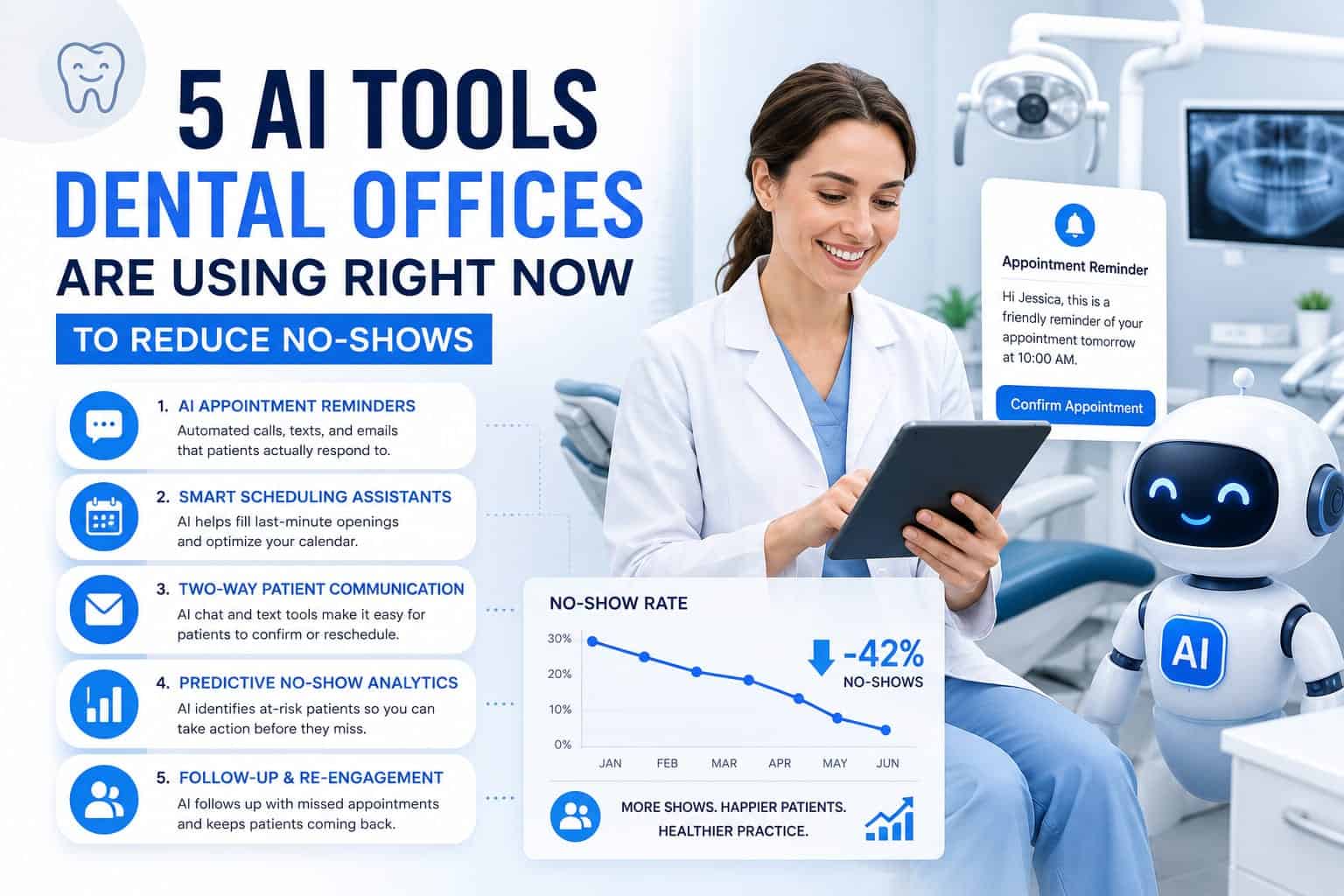
The good news is that artificial intelligence is quietly solving this in dental offices across the country, not through some complicated overhaul of how you operate, but through smart, targeted tools that work in the background while your team focuses on patient care. Here are five that are making a real difference right now.
1. AI-Powered Appointment Reminder Systems
This sounds simple, and at the surface level it is — but the intelligence behind modern reminder systems has come a long way from the robotic phone calls of ten years ago.
Today’s AI reminder tools do several things that older systems couldn’t. They learn which communication channel each patient actually responds to. Some patients reply to texts immediately. Others open emails. A smaller group still prefers a phone call. Instead of blasting everyone with the same message through the same channel, AI systems track response patterns over time and automatically route reminders through whatever works best for each individual patient.
They also adjust timing based on behavior. If a patient has a history of cancelling within 24 hours, the system flags them and sends an earlier, more detailed reminder sequence. If a patient has a perfect attendance record, a single day-before text is enough.
The language has gotten smarter too. Instead of “Your appointment is confirmed for Tuesday at 2 PM,” modern AI reminders are conversational, warm, and include a direct reply option so the patient can confirm, reschedule, or ask a question without calling the office. That frictionless response option alone significantly increases confirmation rates.
Practices using well-configured AI reminder systems typically report no-show reductions of 30 to 40 percent within the first few months.
1. AI-Powered Appointment Reminder Systems
This sounds simple, and at the surface level it is — but the intelligence behind modern reminder systems has come a long way from the robotic phone calls of ten years ago.
Today’s AI reminder tools do several things that older systems couldn’t. They learn which communication channel each patient actually responds to. Some patients reply to texts immediately. Others open emails. A smaller group still prefers a phone call. Instead of blasting everyone with the same message through the same channel, AI systems track response patterns over time and automatically route reminders through whatever works best for each individual patient.
They also adjust timing based on behavior. If a patient has a history of cancelling within 24 hours, the system flags them and sends an earlier, more detailed reminder sequence. If a patient has a perfect attendance record, a single day-before text is enough.
The language has gotten smarter too. Instead of “Your appointment is confirmed for Tuesday at 2 PM,” modern AI reminders are conversational, warm, and include a direct reply option so the patient can confirm, reschedule, or ask a question without calling the office. That frictionless response option alone significantly increases confirmation rates.
Practices using well-configured AI reminder systems typically report no-show reductions of 30 to 40 percent within the first few months.
2. Intelligent Waitlist Management
Every dental office has a waitlist. Very few use it effectively. When a cancellation comes in, the typical process involves a front desk team member manually scrolling through a list, making calls one by one, and hoping someone picks up and can come in on short notice. It is slow, inconsistent, and heavily dependent on who happens to be working that day.
AI waitlist tools change this entirely. When a cancellation happens, the system instantly scans the waitlist and identifies which patients are most likely to fill that slot based on several factors — their proximity to the office, their historical responsiveness to last-minute requests, which provider they’re waiting to see, how long they’ve been on the list, and what time of day or day of week they tend to be available.
It then sends an automated message to the top matches simultaneously, offering the open slot on a first-come, first-served basis. Most practices that implement this find their open slots filling within minutes rather than hours, without any manual effort from the front desk.
One practice manager in Phoenix described it this way: “We used to dread cancellations because filling them was a whole project. Now our front desk barely has to get involved. The slot fills itself most of the time.”
3. Predictive No-Show Scoring
This is where AI starts to do something genuinely impressive — identifying which patients are at high risk of not showing up before the appointment ever arrives.
Predictive no-show scoring tools analyze patterns across your patient database. They look at things like a patient’s cancellation history, how far in advance they booked, whether they confirmed when prompted, the day of the week, the time of the appointment, how long it’s been since their last visit, and dozens of other variables. From all of this, the system generates a risk score for each upcoming appointment.
Your front desk can then focus their outreach energy on the high-risk appointments. A patient with a low risk score gets a standard reminder. A patient flagged as high-risk might get a personal call from a team member, a more detailed reminder sequence, or an earlier confirmation request.
This is smarter than treating every appointment the same way. It conserves your team’s time and directs human attention exactly where it will have the most impact.
Some platforms integrate this directly into your existing practice management software, so the risk scores appear right alongside your schedule without requiring your team to learn a separate system.
4. AI-Driven Patient Communication Platforms
Beyond reminders, there is a broader category of AI communication tools that manage the entire relationship between appointments — and this ongoing engagement turns out to be one of the most effective ways to reduce no-shows in the long run.
Here is the underlying logic. Patients who feel connected to their dental office are less likely to blow off their appointment. Patients who receive nothing from you between visits — no check-ins, no educational content, no birthday message, nothing — have a weaker sense of relationship with your practice and are more likely to cancel without guilt.
AI communication platforms automate this relationship maintenance in a way that feels personal rather than spammy. They send a post-appointment follow-up checking how the patient is feeling after a procedure. They send educational content relevant to that specific patient’s treatment history. They reach out a few weeks before a scheduled cleaning with a friendly heads-up. They send a birthday message. They check in on patients who are overdue for a visit.
None of this requires your team to remember to do it. The AI handles the sequencing and timing automatically based on each patient’s profile and appointment history. The result is patients who feel genuinely looked after, which translates directly into higher show rates and better retention overall.
5. Two-Way AI Chat for Rescheduling Friction
One of the most underappreciated reasons patients no-show is that rescheduling feels like too much work. They know they can’t make Tuesday’s appointment. They intend to call and move it. But calling means being put on hold, explaining the situation, waiting while someone checks the schedule, going back and forth on times. It is friction. And friction causes inaction. So they just don’t show up and deal with the awkwardness later.
Two-way AI chat tools eliminate this friction almost entirely. When a patient receives their appointment reminder, they can reply directly in the text thread — “Actually, can we move this to next week?” — and the AI engages in a natural back-and-forth conversation to find a new time, update the booking, confirm the change, and close the loop. The whole thing takes about 90 seconds and requires zero involvement from your front desk.
When rescheduling is easy, patients reschedule instead of ghosting. It sounds obvious, but the difference in practice is significant. Offices that implement easy two-way rescheduling often see their actual no-show numbers drop even faster than their cancellation numbers increase — because patients who previously would have simply not shown up are now rescheduling in advance, which at least gives you time to fill the slot.
The key feature to look for here is that the AI can handle the full rescheduling conversation without handing off to a human for routine changes. The human handoff should only happen when something genuinely requires judgment — a complex situation, an upset patient, an unusual request.
These five tools are not mutually exclusive. The dental offices seeing the biggest improvements in no-show rates are typically using a combination of them, often integrated through a single patient communication platform that handles reminders, waitlist management, predictive scoring, and two-way chat in one place.
The implementation does not have to be overwhelming. Most practices start with smart reminders and two-way rescheduling because those two alone produce noticeable results quickly. From there, adding predictive scoring and waitlist automation builds on that foundation.
What all five tools share is the same core principle — they remove friction, improve communication, and make it easier for patients to stay engaged with your practice between visits. That engagement is ultimately what turns a one-time patient into a loyal one, and a chronic no-show into someone who actually values and shows up for their appointment.
Your schedule is your revenue. Protecting it with tools that work quietly in the background while your team focuses on care is not a luxury anymore. For dental offices that are serious about growth, it is simply how things get done.