Running a salon means you are constantly pulled in ten directions at once. You’re checking a highlight, answering a DM, mentally calculating whether Jess can squeeze in a blowout at 3 PM, and trying to remember if Mrs. Patterson prefers the left side parted or the right. The last thing you have time for is sitting by the phone managing appointments.
That’s exactly why AI booking assistants have exploded in popularity among salon owners over the past couple of years. But like any tool, they work brilliantly in the right situations and fall completely flat in the wrong ones. This guide is going to be honest with you about both.
What an AI booking assistant actually does
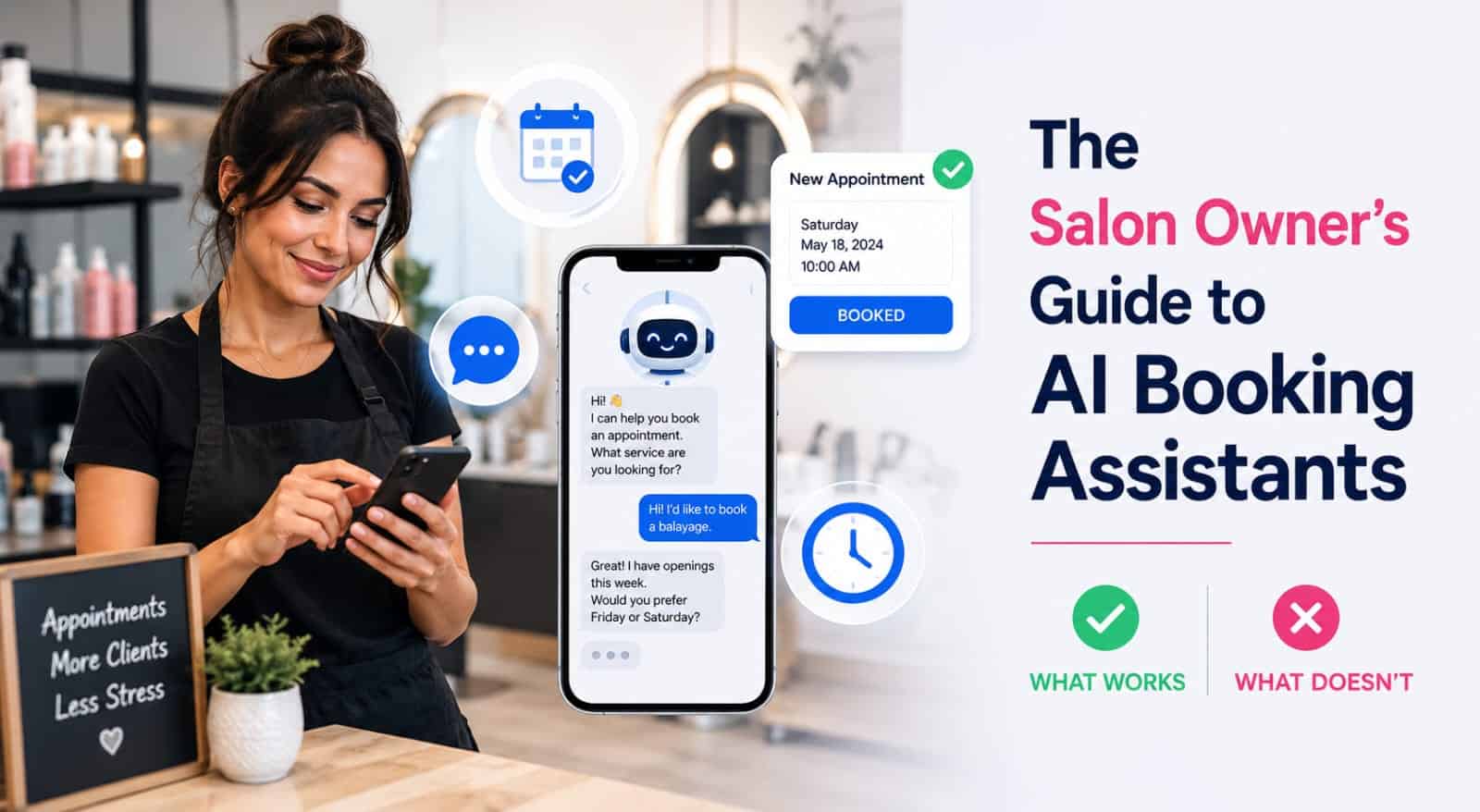
Before we get into the nuances, let’s be clear about what we’re talking about. An AI booking assistant is a software tool — usually connected to your existing booking system — that can communicate with clients through text, chat, or social media DMs to handle appointment scheduling without you or your staff lifting a finger.
A client texts “Can I get a trim Saturday morning?” and the assistant checks availability, offers time slots, confirms the booking, sends a reminder, and logs everything in your calendar. All while you’re shampooing someone else.
The good ones also handle rescheduling, cancellations, follow-up messages after appointments, and basic questions about services and pricing.
What works really well
Appointment confirmations and reminders are where AI assistants absolutely shine. No-shows are one of the biggest profit killers in the salon industry. A good AI system sends a confirmation the moment someone books, a reminder 48 hours out, and a gentle nudge the morning of. Salons that implement this consistently report no-show rates dropping by 30 to 50 percent. That alone can pay for the tool many times over.
After-hours booking is another genuine win. A significant chunk of clients browse and book late at night, on weekends, or during their lunch break — times when you or your receptionist are unavailable or focused elsewhere. An AI assistant captures those bookings in real time instead of letting them wait until morning, when the client may have already moved on or forgotten.
Handling simple, repetitive questions is also something AI does well. “What are your hours?” “Do you offer balayage?” “How long does a keratin treatment take?” These questions eat up enormous amounts of time across a week. Automating the answers frees your front desk to focus on the clients standing right in front of them.
Re-engagement campaigns work surprisingly well too. A good AI system can automatically reach out to clients who haven’t booked in 60 or 90 days with a friendly message and a direct link to schedule. Many salon owners have recovered dozens of lapsed clients this way without any manual effort.
What doesn't work — and where people get burned
Here is where the honest conversation starts.
AI booking assistants struggle badly with complexity. The moment a client says something like “I want to come in with my daughter, she needs a trim, I need a root touch-up, and my friend might join us but she’s not sure yet” — most AI systems either fumble the response, miss part of the request, or give a confusing reply that frustrates the client. Complex multi-service, multi-person bookings still need a human.
Color consultations are another area where AI falls short. A client asking whether they should go platinum or try a lived-in brunette needs your expertise and vision, not a chatbot. If an AI assistant tries to answer styling and color questions with generic responses, it can actually damage the client relationship before they’ve even sat in your chair.
Sensitive situations require human judgment that AI simply doesn’t have. A long-time client who is going through chemotherapy and asking about hair loss options. A bride who is stressed and second-guessing her wedding hair decision. A teenager who seems anxious about a big change. These conversations need warmth, experience, and emotional intelligence. An AI giving a cheerful, transactional response in these moments can feel cold and off-putting.
Pricing conversations can also go sideways. When clients start asking detailed questions about why a service costs what it costs, or want to negotiate or explain their budget, AI tends to either give a rigid scripted answer or get stuck. These conversations are better handled by a person who can read the situation and respond with nuance.
The mistake most salon owners make
The biggest mistake is treating AI as a full replacement for human communication rather than a support layer underneath it.
The best implementations set up clear handoff points. The AI handles the routine — booking, confirming, reminding, answering FAQs. The moment a conversation gets complex, emotional, or requires expertise, it flags a human and passes it over. That handoff, done well, is invisible to the client. Done poorly, it creates confusion and makes your salon feel impersonal.
Some owners also make the mistake of using an AI assistant with generic, robotic language that doesn’t match their brand voice at all. Your salon has a personality — whether that’s warm and nurturing, fun and edgy, or luxurious and calm. Your AI messages should sound like you, not like a customer service manual. Most platforms allow you to customize the tone and language. Use that feature. It matters more than people think.
Questions to ask before choosing a platform
Not all AI booking tools are built the same. Before you commit to one, ask these questions.
Does it integrate with your existing booking software, or will you have to switch systems entirely? Does it allow custom message templates so you can match your brand voice? How does it handle a message it doesn’t understand — does it fail gracefully and hand off to a human, or does it send a confusing automated response? What does the setup process look like, and how much ongoing maintenance is required? Can you see the full conversation history, so you know exactly what your clients have been told?
Also ask about the failure rate. Every AI system misunderstands messages sometimes. What matters is what happens next. The best systems recognize when they’re out of their depth and say something like “Let me have someone from the team follow up with you on this” — and then actually do it.
A realistic picture of the results
Salon owners who implement AI booking assistants well — meaning they use them for the right things and maintain human touchpoints where it matters — typically see fewer no-shows, more after-hours bookings captured, less time spent by staff on repetitive administrative tasks, and faster response times to new client inquiries.
Salon owners who implement them poorly — meaning they use AI to handle everything and remove the human element entirely — often see client complaints about feeling like they’re talking to a machine, confusion around complex requests, and occasionally a hit to their reputation when something goes wrong and there’s no person there to smooth it over.
The technology is genuinely useful. It is not magic, and it is not a replacement for the relationships that make a great salon great.
AI booking assistants are one of the most practical tools available to salon owners right now, particularly for handling volume, reducing no-shows, and capturing bookings outside business hours. But they work best as a foundation, not a ceiling.
Use them to handle what’s routine so your team can focus on what’s personal. That’s the balance that actually works.
Your clients come back because they trust you, because you remember them, and because sitting in your chair feels like a small act of self-care. No AI is going to replace that. The good news is, it doesn’t have to.